



Ball valve or gate valve: which valve is the right choice when?
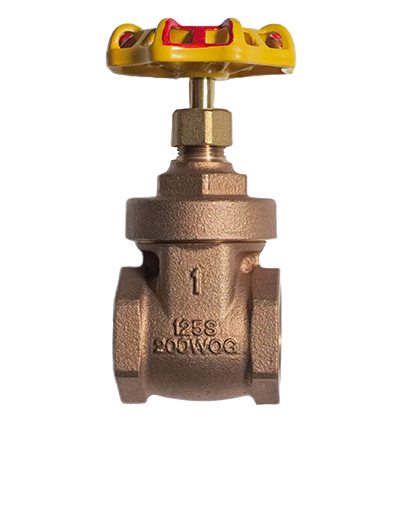
Two shut-off valves, two principles
Ball valves and gate valves are both valves that are designed to shut off or open pipes. Nevertheless, they differ fundamentally in terms of function, operation, maintenance requirements and typical fields of application. If you want to make the right choice, you need to understand both principles and know when each system comes into its own.
How a ball valve works
The ball valve has a drilled ball in the housing. If the handle is turned by 90 degrees, the hole is aligned with the pipe cross-section and the medium can pass through unhindered. In the closed position, the ball rotates so that the hole is at right angles to the direction of flow and completely blocks the medium. The principle is simple, robust and quick to operate. When open, a ball valve offers minimal flow resistance as the full pipe cross-section is released.
HSE ball valves are available for drinking water, heating and gas and, with the UNIDUO, for both applications simultaneously. All models are available with different handle variants and connection designs.
How a gate valve works
With a gate valve, a gate plate is pushed into or pulled out of the pipe by turning a spindle perpendicular to the direction of flow. Complete opening requires several turns. When fully open, the plate lies in the housing and releases the pipe cross-section, which also enables very low pressure loss.
However, the gate valve is not a fast-acting component. It is suitable for situations in which the valve is rarely opened or closed and in which slower actuation is more of an advantage because pressure surges in the line should be avoided.
Where the ball valve has its strengths
Today, the ball valve is the dominant shut-off valve in building services, heating systems, drinking water installations and gas systems. It is compact, quick to operate, leak-proof and low-maintenance. The position indicator is clear: handle parallel to the pipe means open, handle across means closed. This reduces confusion during maintenance work.
Ball valves are particularly suitable when valves are operated frequently, when quick shut-off is required in the event of a malfunction and when little installation space is available. They also require less maintenance than gate valves because regular lubrication of the spindle is not necessary.
Where the slider has its justification
Today, gate valves are mainly used in public water supply systems, in larger nominal diameters and in industrial plants where the slower actuation is used specifically to avoid pressure surges. Gate valves have become less common in domestic installations, but for certain special situations, such as very large pipe diameters or in piping systems with special flow requirements, they may be the better choice.
Practical decision-making aid
The decision between ball valve and gate valve can be based on three criteria: How often is the valve operated? How quickly must the valve be shut off? And what nominal size is required? In domestic installations up to a nominal diameter of DN 50, the ball valve is the better choice in almost all cases. All available series and technical details can be found in the data sheets in the download area.
Conclusion: ball valve or gate valve
Today, the ball valve is the clear first choice for building services. It is compact, fast, tight and easy to maintain. Gate valves are justified in larger nominal sizes and in the supply infrastructure, where other operating conditions apply. HSE Armaturen offers a complete range of ball valves for domestic installations for drinking water, heating and gas.
If you have any questions about choosing the right fitting for your application, please contact us. Contact us now.

