


Drinking water ball valves: handle, connection and use at a glance
Why drinking water ball valves must meet special requirements
A ball valve is not just a ball valve. Anyone using a fitting in the drinking water sector must ensure that it is approved for this use, meets hygiene requirements and remains leak-proof in the long term. Valves that do not meet these requirements can impair drinking water quality and cause problems when they are approved by a specialist company.
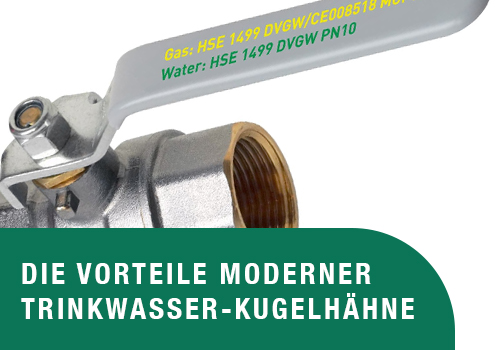
HSE drinking water ball valves from the Uniwater series are DVGW-certified under the registration number NW-6102AT2438, have noise class I and are designed with optimized dead space to prevent the formation of legionella in stagnant water areas. The CW 617 N material used is approved for use in drinking water systems.
Handle variants: Which version fits where
HSE drinking water ball valves are available in three different handle versions. The choice of the right handle design depends on the installation location and accessibility. In confined shafts or behind cladding, a narrow flat handle that requires little space makes sense. In easily accessible areas, a lever handle offers better handling during operation.
Regardless of the handle variant, the position indicator is important: a correctly labeled or colour-coded handle shows at a glance whether the fitting is open or closed. This is a clear advantage, especially during maintenance work and in emergency situations.
Connection types and installation situations
Drinking water ball valves are available in various connection designs. The classic version with external thread can be connected with standard fittings. HSE Uniwater system ball valves with male threads on both sides make it easier to comply with the installation regulations of DVGW worksheet W 570. They can be connected with all half screw connections of commercially available press connections and can therefore be replaced without changing the pipe routing.
For systems with Viega Profipress, all ball valves are also available complete with the corresponding screw connection. This simplifies installation considerably and reduces the time required on site.
Emptying as a practical additional function
Models with integrated draining are particularly useful if individual pipe sections need to be drained regularly, for example during maintenance work or when outside pipes are not used in winter. If you choose the version with drainage, you do not need an additional KFE tap for the system, which saves costs and installation work.
All available models, dimensions and technical specifications can be found in the product overview of drinking water ball valves and in the data sheets in the download area.
Practical selection guide for use
Three questions help when choosing the right drinking water ball valve: What nominal diameter is required? What type of connection is available on site? And how easily accessible is the installation location? With these three details, the series can be narrowed down quickly. For unclear installation situations or special cases, the HSE team is available for technical queries.
Conclusion: Using drinking water ball valves correctly
Drinking water ball valves are not mass-produced goods, but technically defined products with clear approval requirements. Those who rely on certified valves such as the HSE Uniwater series are on the safe side, both during approval and in continuous operation. The handle variant, connection type and draining option can be flexibly adapted to the respective situation.
If you need assistance with your selection, we will be happy to help you. Contact us now.

